

Why more battery capacity comes at a cost
News originally published by
EIN Presswire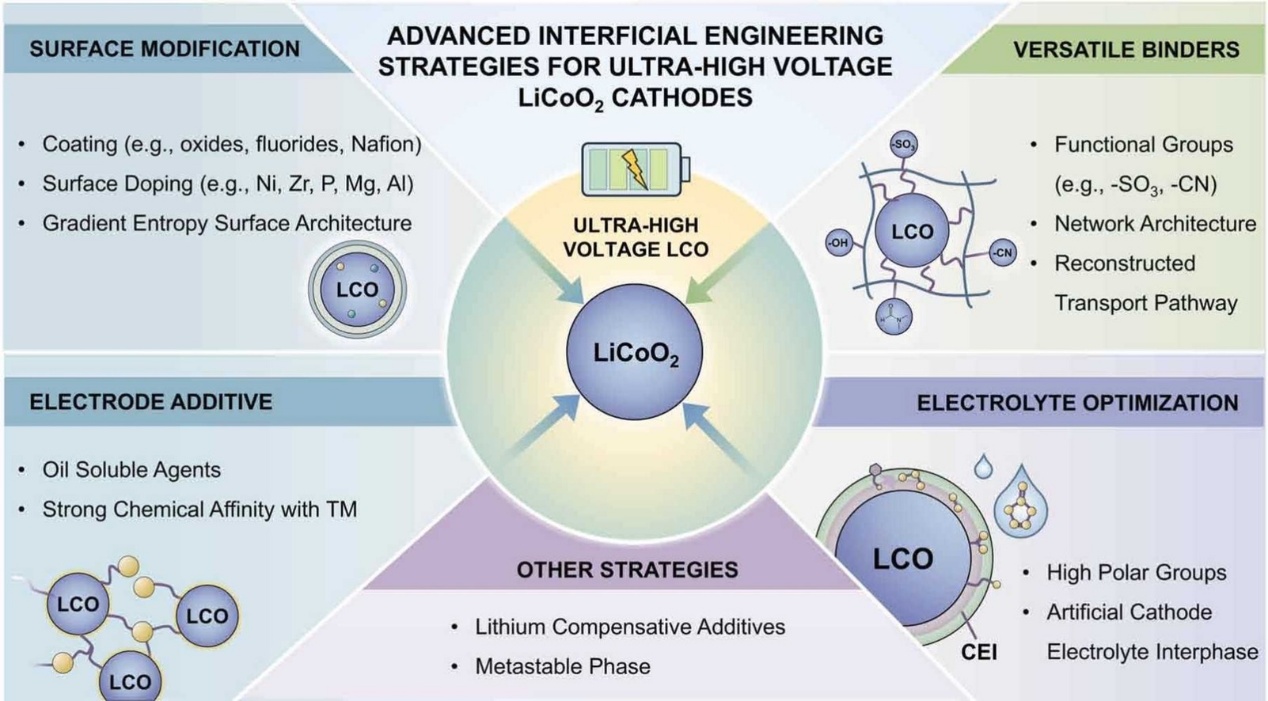
Graphical Abstract.
GA, UNITED STATES, November 27, 2026 /EINPresswire.com/ -- Lithium cobalt oxide (LiCoO2, LCO) is widely used as a cathode, or positive electrode material, in portable electronics because it combines high energy density with a mature manufacturing base. Raising the charging cutoff voltage of LCO can significantly increase its reversible capacity in practice. However, the challenge is keeping that extra capacity through repeated charging.
Researches from Southern University of Science and Technology, City University of Hong Kong, and Zhejiang University trace the problem to two processes that reinforce each other: changes inside lithium cobalt oxide particles and chemical reactions where those particles meet the electrolyte in a review in eScience Energy, published (DOI: 10.1016/j.esen.2026.100119) on 20 August 2026. The authors argue that protective coatings, electrode binders and electrolyte formulations should be designed to work together. These approaches could help researchers develop batteries that store more energy in the limited space available in portable electronics.
The review puts the typical reversible capacity of Lithium cobalt oxide (LiCoO2, LCO) at about 180 milliampere-hours per gram at a charging cutoff of 4.45 volts. Raising the cutoff to 4.6 volts or higher can push that figure above 220 milliampere-hours per gram of cathode material in reported tests. The higher cutoff draws more lithium out of the particles, but it also strains their crystal structure and accelerates reactions with the electrolyte. The key is to understand how these processes reinforce one another and where a battery design could interrupt them. According to the review, researches linked findings from earlier studies on particle damage and electrolyte breakdown to strategies designed to slow those processes. Their framework treats the cathode surface as the point where damage inside the particle and reactions in the surrounding electrolyte meet. One route through that feedback loop begins when oxygen in the crystal becomes reactive.
As more lithium ions extracted from the cathode crystalline during charging, oxygen in the crystal can become reactive and escape from the surface lattice. The remaining atoms can rearrange into structures that make it harder for lithium ions to move back into the cathode. Meanwhile, the electrolyte can break down at high voltage, producing compounds that corrode the surface and dissolve cobalt. decomposition byproducts can also accumulate in a resistive layer that further restricts ion movement. The review evaluates ways to intervene at several points. Surface coatings can reduce chemical attack, while doping and composition gradients help stabilize the underlying crystal. Designs that combine these approaches can assign different functions to the outer surface and the particle interior, balancing protection with electrochemical activity. In one study summarized in the review, a cathode with a modified surface composition retained 80.6% of its initial capacity after 100 cycles at a charging cutoff of 4.7 volts.
The same reasoning extends to electrode components. Functional binders, which hold the electrode together, can also be designed to anchor more firmly to particles or suppress damaging reactions. Additives introduced during electrode preparation can target reactive surface sites or intercept reactive species produced during electrolyte oxidation. The review also describes additives that address specific losses, such as compounds that supply extra lithium to compensate for lithium consumed by irreversible reactions. Electrolyte formulations can then guide the formation of protective interphases at both electrodes. The challenge is to make these functions compatible throughout cycling.
Looking ahead, the authors call for measurements that follow chemical and mechanical changes together during operation. Coupling such observations with predictive modelling could help identify which degradation processes limit a particular design. They also propose using machine learning to narrow the search for compatible coatings, dopants and electrolyte formulations, and highlight solid-state batteries as a further setting for interface development.
The most immediate application for LiCoO2 cathode material is in battery development for portable electronics, where storing more energy in the same space could extend runtime. The results summarized in the review show that some designs can retain substantial capacity in laboratory cycling tests. For battery developers, the next question is whether those designs can deliver reliable performance over longer periods in complete cells. Manufacturers would also need to apply coatings uniformly, control the distribution of added elements, and fit those steps into existing electrode production. The authors call for assessing the cost and environmental impact of combining treatments and considering whether coatings and other modifications would complicate recovery of cobalt-bearing material after use.
DOI
10.1016/j.esen.2026.100119
Original Source URL
https://doi.org/10.1016/j.esen.2026.100119
Funding information
This work was financially supported by the National Natural Science Foundation of China(No. 92372114), the Guangdong−Hong Kong−Macau Joint Innovation Fund (No. 2024A0505040001), and the Natural Science Foundation of Guangdong Province (No. 2024A1515010346). Dr. N. Qin acknowledges the financial support from China Postdoctoral Science Foundation under Grant Number 2023M742972 and Postdoctoral Fellowship Program of CPSF under Grant Number GZB20240652, and the National Natural Science Foundations of China (NSFC, No. 22509183).
Lucy Wang
BioDesign Research
Legal Disclaimer:
EIN Presswire provides this news content "as is" without warranty of any kind. We do not accept any responsibility or liability for the accuracy, content, images, videos, licenses, completeness, legality, or reliability of the information contained in this article. If you have any complaints or copyright issues related to this article, kindly contact the author above.
